
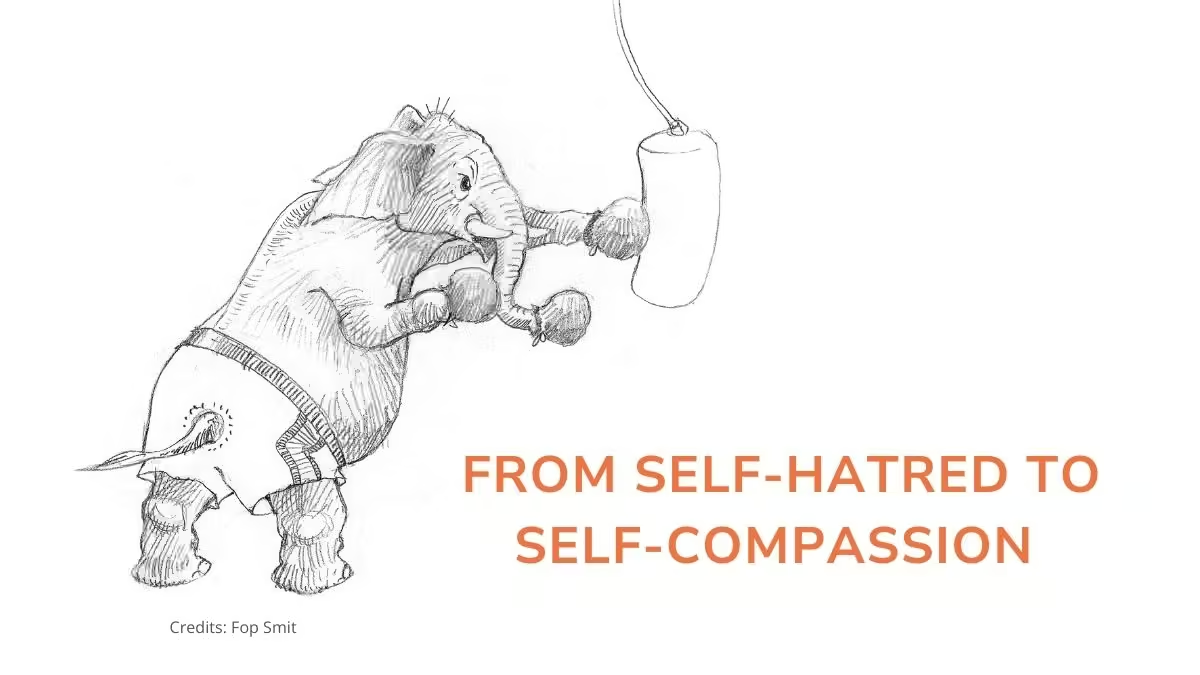
During my last silent retreat, after a few days, an old memory suddenly came to mind: I remembered a situation in which I had not behaved particularly elegantly or wisely.
The memory stuck with me and resurfaced regularly over the next few days, accompanied by various ‘unpleasant’ emotions. This continued until I suddenly asked myself, ‘What is actually happening here?’ Spontaneously, a word came to mind that I had hardly ever used in my life, probably because it evoked aversion and had always been taboo. It was the word ‘self-hatred’.
I realised, ‘This is a situation in which self-hatred plays a role and proliferates.’
This realisation and mindful acknowledgement caused this painful issue to dissipate, so to speak, and gave way to a deep, connected calm.
Paul Gilbert, clinical psychologist and developer of Compassion Focused Therapy (CFT), distinguishes between the ‘inadequate self’ (disappointment) and the ‘hated self’. The latter is characterised by active hostility and the desire to punish oneself.
In retrospect, I also realised how often I had hindered and sabotaged myself in my life – visibly and invisibly, obviously and subtly. I also realised that this is not just something that happens to me, but that it is a general human tendency or pattern that can cause a great deal of suffering.
Mindful recognition can be seen as a healing and expansive response or as a homeopathic antidote.
Furthermore, cultivating compassion can be very important for our relationships with others. ‘Love, compassion and tolerance are not luxury goods, but basic necessities. Without them, humanity cannot survive’, the Dalai Lama once said.
In the Mindfulness-Based Compassionate Living (MBCL) compassion training developed by Erik van den Brink and myself, we explore the topic of compassion for oneself and others in a non-religious way. The evidence-based training is designed as an advanced course for people who have already been practising mindfulness for some time.
Studies show that MBCL effectively and sustainably supports people in developing more self-compassion and alleviates self-hatred and self-criticism. This benefits not only themselves, but also others.
A warm welcome.